The $2 value meal could be a game changer for Taco Bell

Share
“Taco Bell’s two dollar value meal is potentially game changing,” says Gary Stibel, Founder and CEO of the Westport, Connecticut based New England Consulting Group. And Stibel should know because he was one of three New England Consulting Group partners who worked with Taco Bell when they were still owned by PepsiCo to create the original version of the modern day value meal (in the late 1980s).  “We were fortunate enough to have worked with Taco Bell on this project along with some of the best and brightest from both the restaurant chain and from PepsiCo corporate.”

Since then, value meals have become a mainstay of the industry, particularly during the recession.  Today, Stibel points out that “many restaurants are hooked on discount ‘heroin’ that is teaching guests very bad habits and restricting profits, particularly as the recession wanes”. “Therefore, the two dollar meal deal could be a transitional game changer for Taco Bell.  One dollar meals drastically limit the quantity a restaurant can offer and often leave consumers wanting.  This is strategic to Taco Bell because the bullseye of their target audience is the young male who doesn’t eat restaurant food, he ‘hoovers’ it. The five dollar footlong is one of several great examples of creative marketing at a very profitable price point that provides real value to the consumer.”

And Stibel goes on to point out that “price is not a number, it’s an equation!  Whether or not consumers could buy the contents of a value meal for the same amount of money has little relevance.  What is relevant is the fact that consumers derive great value from being able to go in, order a ‘bundle’ of products and services quickly and easily, and be satisfied with what they receive for what they pay.  This is true of value meals from Taco Bell, packaged minutes from cell phone providers, triple play options from cable operators, and much more.”

In fact, Stibel attributes analogue modeling from other categories as “the spark that ignited the original Taco Bell value meal.  Ditto the original cable triple play offering over ten years ago”. David Stone, a Managing Partner and Principal at the New England Consulting Group and the original Chief Marketing Officer of Taco Bell, points out that “one of the bases for PepsiCo’s acquisition of Taco Bell was the ability to deliver good tasting, filling foods to young men at prices that were attractive to the guest and profitable to the owner.  It is one of the strengths of Mexican food in a crowded QSR marketplace.”

Stibel goes on to point out that value is not isolated to QSR.  He specifically cites Olive Garden and Applebee’s as examples of chain restaurants who are delivering compelling value propositions at price points approaching double digits and still very profitable to the chains.”

Restaurants to Add 428,000 Summer Jobs in 2010, According to National Restaurant Association Projections

Share
Restaurants are expected to add 428,000 jobs this summer season, a 4.6 percent increase over the March 2010 employment level, according to National Restaurant Association projections released today.  America’s restaurants are the nation’s second-largest private-sector employer and job-creator—with nearly 13 million employees—a number projected to grow by more than one million positions in the next decade.

“In these tough economic times, restaurants are playing an ever more important role in their communities, creating jobs and economic opportunity for our nation,” said National Restaurant Association President & CEO Dawn Sweeney. “Every dollar spent in restaurants generates an additional $2.05 spent in the overall economy,” she added.
“Restaurant industry job growth has been positive for the first five months of 2010, paving the way for additional growth in summer employment,” said Hudson Riehle, senior vice president of the research and knowledge group for the Association.

The restaurant industry is usually the nation’s second-largest creator of summer jobs – ranking behind the construction industry only.  Eating and drinking places added 422,100 jobs (a 4.6 percent increase) during the 2009 summer season, and 352,900 jobs (3.7 percent increase) during the 2008 summer season. Last year, however, the construction sector only added 259,300 jobs during the 2009 summer season, well below hiring in the restaurant industry.
The states projected to add the most eating and drinking place jobs during the 2010 summer season are New York (38,300), California (30,400), Texas (28,100), Massachusetts (24,800), New Jersey (24,600), Illinois (19,900), Ohio (19,800) and Michigan (18,600).  

The states projected to register the largest proportional employment increase during the 2010 summer season are Maine (30.9 percent increase) and Alaska (26.0 percent increase). For more information and summer employment projections by state and trends, visitwww.restaurant.org/pressroom.

Founded in 1919, the National Restaurant Association is the leading business association for the restaurant industry, which comprises 945,000 restaurant and foodservice outlets and a work force of nearly 13 million employees. Together with the National Restaurant Association Educational Foundation, the Association works to lead America’s restaurant industry into a new era of prosperity, prominence, and participation, enhancing the quality of life for all we serve.

Hardee's rolls out chicken tenders

Share
Taking a tip from one of its largest franchisees, Hardee’s parent CKE Restaurants Inc. said it was adding chicken tenders to the chain's menu.

The new Hand-Breaded Chicken Tenders are made with white-meat chicken breast tenderloins dipped in a buttermilk and egg batter, rolled in seasoned flour and then fried. The tenders are available in three- and five-piece orders for $2.99 and $4.49, respectively, with a choice of honey mustard, creamy Buffalo or buttermilk ranch dipping sauces. They're also available as part of a combination meal with fries and a beverage, or as an option on the kid’s menu.

Brad Haley, executive vice president of marketing for Hardee’s and sister brand Carl’s Jr., said the idea for hand-breading the tenders came from Boddie-Noell Enterprises, based in Rocky Mount, N.C., which also pioneered the chain’s popular Made From Scratch biscuits about 25 years ago. Boddie-Noell introduced the chicken tenders in a casual-dining steak restaurant it operates and the item has become one of the most popular on the menu.

“Once we tried them, we knew customers would find them irresistible because they represent such a huge quality leap over the mostly pre-cooked and frozen chicken strips available now,” Haley said. “Obviously, our Hand-Breaded Chicken Tenders are a lot more work to make than the pre-cooked, frozen ones, but our experience tells us that consumers will notice the difference in quality and keep coming back for more.” CKE said the rollout to participating restaurants within the 1,905 Hardee’s chain is expected to be complete by the end of the month.

The chicken-focused item also comes at a time when analysts are expressing concern over the impact rising ground beef costs will have on fast-food chains. Steve West, an analyst with Stifel Nicolaus in St. Louis, estimated in a recent report that ground beef prices this year will be up by 20 to 30 percent over last year's.

Friday's adds summer cocktails

Share

Adding to the growing number of craft cocktails in bars and restaurants, T.G.I. Friday's unveiled eight Caribbean-inspired drinks.
The island cocktails are available for a limited time and include:
  • Coco'Mon n'Lime, made with two kinds of rum, lime juice and cola.
  • Tropical Fruit Coladas, with the flavors of passion fruit, strawberry or peach.
  • Island Rum Punch, with spiced and dark rums, almond-flavored liqueur, passion fruit puree and pineapple juice.
  • Tropical Mai Tai, with a mix of spiced rum and pineapple and peach nectars.
  • Fresh Mango Lemonade, with vodka, rum, lemon-agave sour mix and mango puree.
  • Mango Berry Daiquiri, with rum, peach schnapps, mango and strawberry purees and house-made lime-sour mix.
"These signature cocktails are made with fresh, high quality ingredients such as freshly squeezed limes and fresh cut pineapple,” said George Barton, Friday’s vice president of beverage and bar innovation.
Friday's joins several restaurants across the country that have introduced special cocktails for summer. 
T.G.I. Friday’s, a division of Carlson Restaurant Worldwide Inc., has more than 900 restaurants in 60 nations with about 600 in the United States.

Pinkberry to add watermelon flavor for summer

Share
The 85-unit Pinkberry frozen yogurt chain is launching a new watermelon flavor later this month paired with an unusual topping.

Beginning June 25, Pinkberry will begin serving the watermelon flavor, which is served with a fresh watermelon puree. The chain also will recommend that guests top the treat with diced watermelon and Persian cucumbers.

“The first time you hear about cucumbers, you think that seems weird. But when you try it, it clicks,” said Suzanne Ginestro, Pinkberry’s vice president of brand management. The limited-time offer, which officials estimate will last six to eight weeks, is an example of Pinkberry’s plan to move into “more provocative” flavor combinations, said Ron Graves, the Los Angeles-based chain’s president and chief executive.

While the watermelon flavor is available, Pinkberry stores will host daily "happy hour" specials from 5 p.m. to 7 p.m., when the flavor will be available at half price. Pinkberry will open its first location in Mexico City this week, chain officials said. The chain already has a presence in Kuwait, Dubai and Bahrain.

Pinkberry also is expanding domestically, with a location scheduled to open next week in Atlanta. Later this year, the chain will open stores in Charlotte, N.C.; Orlando, Fla.; northern Virginia; Boston; and Nashville, Tenn.

Analyst: Fast-food sales won't rise until unemployment falls

Share

Several fast-food chains may have to wait until more young men find jobs before seeing same-store sales rise, according to a restaurant analyst. Jefferies & Co. restaurant securities analyst Jeff Farmer said in a note to investors this week that an analysis of ten years of quarterly same-store sales trends and unemployment data shows that same-store sales for three chains – Jack in the Box, Sonic and Burger King – are the most highly correlated with the unemployment rate. The chain sales dip as unemployment rises, he said.

Farmer also noted that same-store sales at one company – Domino’s Pizza Inc. – actually appear to improve as the unemployment rate rises. Farmer noted all three restaurant chains that were hit hardest by mounting job losses cater to a young, male demographic, which had an unemployment rate of 18.2 percent in May. The U.S. Department of Labor announced a May unemployment rate of 9.7 percent last week, with total nonfarm payroll employment up by 431,000. However, much of that increase stemmed from the addition of several hundred thousand temporary U.S. Census workers. Farmer noted that when controlling for those hires, job growth fell 41,000 during the month.

The analyst also said that job losses in 2008 and 2009 were concentrated in a number of sectors, including construction and retail trade. Those two sectors, he said, employ a large number of 18-24 year-old males and Hispanics. “With both sectors seeing job losses in May 2010, the waiting game continues,” Farmer said in the note. “We believe the Jack in the Box, Sonic and Burger King concepts all need to see sustained job growth from the construction and retail trade sectors in order to see the return of healthy same-store sales growth.”  

All three chains have seen same-store sales drop as the recession continues to impact spending and employment trends. Jack in the Box Inc., for example, reported a same-store sales decline of 8.6 percent for the quarter ended April 11, while Sonic Corp. said its systemwide same-store sales fell 13.2 percent for the three months ended Feb. 28. Jack in the Box spokesperson Brian Luscomb said the company agreed with Farmer’s thesis, saying the company does not expect “significant improvement in underlying fundamentals” until the unemployment rate improves. “Forty-four percent of our restaurants are located in the ten states with the highest unemployment,” he noted. 

Burger King Corp. also has struggled to keep same-store sales growing. For the three months ended March 31, the company reported a worldwide same-store sales decline of 3.7 percent, with same-store sales in the U.S. dropping 6.1 percent. Farmer said 26 percent of Burger King’s restaurants are located in the states hardest hit by unemployment. McDonald’s Corp. has been one of the bright spots in the quick-service space. The chain reported Tuesday that its global same-store sales rose 4.8 percent in May, with same-store sales up 3.4 percent in the U.S. 

Farmer said McDonald’s U.S. same-store sales have the lowest correlation with the unemployment rate, which is “the result of the concept’s very broad customer base across age, income and regional demographics.”

Thanks Lauren Shepherd at NRN


Several Subways linked in salmonella outbreak

Share
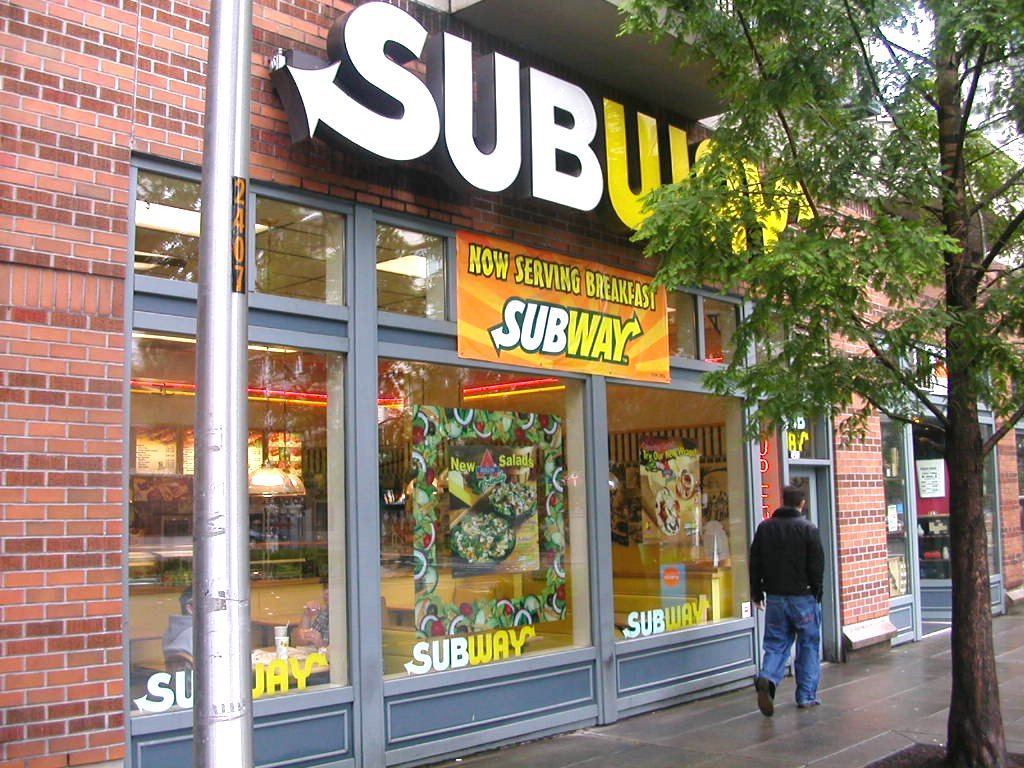
Subway is working with public health agencies investigating a salmonella outbreak involving units of the chain in 22 counties in Illinois, the state's Department of Public Health said Thursday. The department said 71 people have been sickened by the outbreak of the Hvittingfoss strain of salmonella, a relatively rare serotype of the bacteria typically associated with only one or two illnesses a year in the state. 

Illnesses of the Subway-linked outbreak were reported to have started between May 11 and May 25. All of those who were sickened, including 17 who required hospitalization, are recovering, Illinois health officials said. Subway and state officials said that while no specific food in the restaurants has been confirmed as having an association with the outbreak, the chain voluntarily withdrew all lettuce, green peppers, red onions and tomatoes from the suspected dates from its restaurants, replacing those products with newer ones. “The Subway brand will continue to work with the Department of Health to assist in pinpointing the exact cause of the outbreak,” a representative for the chain said Monday. 

Subway is owned by Milford, Conn.-based Doctor’s Associates Inc. and has more than 32,000 franchised restaurants worldwide, including 23,000 in the United States. The affected Subway restaurants are located throughout 22 counties in Illinois, including Bureau, Cass, Champaign, Christian, Coles, Dewitt, Fulton, Knox, La Salle, Macon, Marshall, Moultrie, Ogle, Peoria, Sangamon, Schuyler, Shelby, Tazewell, Vermilion, Warren, Winnebago and Will.

The Illinois health department said it is working with Subway, the Food and Drug Administration, the Centers for Disease Control and Prevention and several local health departments as it continues to investigate the outbreak.
Subway said food safety is “of paramount importance” to the chain. Subway augments regular public health department inspections of its restaurants with monthly inspections by regional chain personnel, who work with store operators to train staff in safe food handling and preparation techniques, and the chain and designated third-party auditing companies regularly inspect produce vendors.

In March, a franchised Subway restaurant in Lombard, Ill., was associated with more than 116 confirmed cases of shigella illness, 13 of which required hospitalization. The restaurant was closed for about a month for testing, cleaning, restocking and supplemental staff training, but a definitive source of the outbreak has yet to be announced by public health officials. 

Thanks Alan J. Liddle at NRN


Copyright © 2010 NoGroceries.com ::: Feed that Appetite Report All rights reserved.
Wp Theme by Templatesnext . Blogger Template by Anshul